
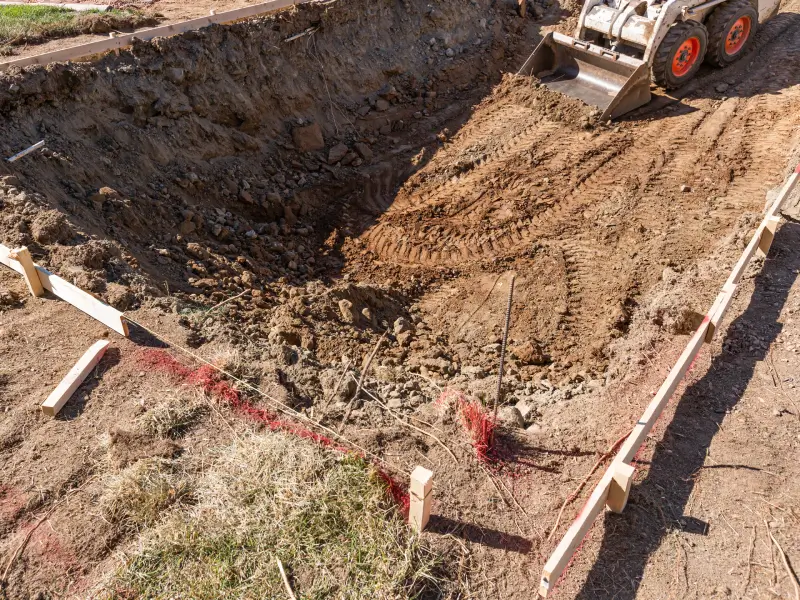
A complete excavation company bid names six things: site access, material removal, rock handling, a grading tolerance, drainage, and cleanup. Bids that skip any of them aren’t cheaper. They’re smaller on paper, and the missing work comes back later as a change order.
Most property owners compare estimates by looking at the number at the bottom. That number tells you the least about the job. Two excavating contractors can walk the same three acres outside Bertram in the same week and hand you proposals that differ by six thousand dollars. Neither one is dishonest. They’re describing different amounts of work.
Our complete guide to excavation covers what happens on site, from the first cut to final grade. This one covers the part that happens before any dirt moves: reading the paper in front of you.
What a Complete Excavation Estimate Should Include
What should an excavation company estimate include? A complete estimate lists mobilization and site access, topsoil and material removal, rock handling with a unit rate, a stated grading tolerance, drainage or erosion work, and final cleanup. Anything missing from that list is work that still has to happen and gets priced later.
A bid is a scope document, not a price tag. When a line item is absent, the work doesn’t disappear. It moves from the contract into a phone call three weeks later, when you have no leverage and no second quote.
Here’s the pattern we see most often on pad jobs in Burnet County. A landowner wants a level pad for a barndominium. One bid comes in around $8,000. Another lands near $15,000. Same property, same soil, same week.
The lower bid says “excavate and grade building pad.” Five words. The higher one runs a full page: cubic yards of cut, cubic yards of fill hauled in, rock excavation at a stated hourly rate, pad compacted to a set density, and drainage swales cut on two sides.
The second document isn’t padded. It’s finished. Those figures are typical rather than one specific job, but the gap repeats.
Did You Know: A single cubic yard of soil can weigh well over a ton once moisture and density are figured in. That weight is why haul-off and fill quantities move a bid more than machine time does. When quantities aren’t listed, nobody has actually measured the job.
Rock Is the Line Item That Decides the Budget
Shallow limestone and caliche sit close to the surface across much of Burnet, Lampasas, and Williamson counties. On one property the rock starts at four feet. Two hundred yards away it starts at eight inches. That single difference can swing a pad price by half.
The industry has a name for what happens next. When what’s underground turns out different from what the contract assumed, it’s called a differing site condition, and standard construction contracts handle it one way: a change order. That’s the industry stating in writing that unpriced rock becomes your bill.
How We Price Rock Before We Hit It
Before we quote a pad or a pond, we dig test holes with a mini excavator across the footprint. Not one hole in the middle. Several, spread out, because Central Texas rock does not lie flat.
Then we price rock as a separate unit rate instead of burying a guess in the lump sum. If we hit less than expected, you pay for less. A contractor who quotes rock as part of one flat number is either padding the whole bid to cover the risk, or planning to renegotiate when the bucket starts bouncing.
Pro Tip: Ask any bidder one question: “What happens to the price if you hit rock at two feet?” A contractor who has probed the site will give you a number. One who hasn’t will change the subject.
The Line Items Owners Forget to Ask About
Three pieces of scope get left off cheap bids most often. Each becomes your problem after the equipment leaves.
Utility Locates and Trenching
Texas law requires anyone disturbing the ground to notify 811 at least two business days before digging, and that covers pad excavation on your own land, not just utility lines. Filing a ticket isn’t the same as getting a locate, and industry damage data shows locates arrive on time for only about half of tickets. Ask any bidder what they do while a locate is late.
On rural tracts, old water lines, propane runs, and septic laterals rarely appear on any map. If your project needs water, power, or septic runs, ask whether trenching is in the same contract or a separate mobilization later. Trench work also carries its own safety requirements, and OSHA’s excavation standards call for protective systems in any trench five feet or deeper.
Drainage and Erosion Control
A pad cut into a slope changes where water goes. That’s not a side effect. It’s the main thing excavation does.
If a bid moves dirt without addressing runoff, you’ve bought a problem instead of a solution. Ask whether swales, slope stabilization, or erosion control measures are included, or whether the plan is to cut the pad and hope. Proper land grading and site prep sets elevations so water leaves the building envelope on its own.
The Access Road Nobody Priced
Equipment has to reach the work, which often means a haul route across pasture that gets rutted and stays that way. Ask who restores it, and whether your existing drive can carry loaded dump trucks. A soft caliche drive under repeated axle loads washboards fast. If the route in is a gravel driveway, that repair work may belong in the contract from the start.
Pro Tip: Photograph your access route and pasture before work starts. Time-stamped photos settle every restoration disagreement before it becomes one.
How to Compare Two Bids Side by Side
Put both documents next to each other and score them on scope, not price.
| Line Item | Complete Bid | Incomplete Bid |
| Quantities | Cubic yards of cut and fill listed | “Excavate as needed” |
| Rock | Separate unit rate, test holes noted | Not mentioned |
| Grading | Tolerance stated, pad compacted | “Grade level” |
| Drainage | Swales or slope work included | Not mentioned |
| Access | Haul route and restoration named | Not mentioned |
| Cleanup | Debris hauled, site raked | “Clean up after” |
Did You Know: Texas issues no state license for excavation, grading, or general contracting. Electricians, plumbers, HVAC techs, and well drillers all have to carry one. The crew cutting your building pad does not. Proof of general liability insurance and a written scope are the only real protection a property owner has.
If one bid names quantities and the other doesn’t, you aren’t comparing prices. You’re comparing a measured job to an estimate someone made from the truck window. Ask the lower bidder to add the missing lines. Their revised number tells you what the job actually costs, and sometimes the two bids land within a few hundred dollars of each other.
Get a Bid You Can Actually Compare
The lowest number on a page usually reflects the smallest scope, not the best value. A bid that names quantities, prices rock separately, states a grading tolerance, and accounts for drainage and access gives you something you can hold a contractor to. A vague one gives you a starting point for a negotiation you’ll have later, on their terms.
If you’re weighing quotes for a pad, driveway, pond, or site prep job in Burnet, Lampasas, Bell, Travis, or Williamson County, we’ll walk your property, dig test holes, and put a line-item estimate in your hands at no cost. Request a free site visit from TexTerra Solutions and bring your other bids. We’ll tell you what’s missing from them, even if you hire someone else.
Frequently Asked Questions
How much does an excavation company charge per hour? Most Central Texas excavation work runs on a project quote rather than an hourly rate, because hours depend on rock and haul distance. When hourly pricing is used, it typically covers machine plus operator. Ask what the rate includes before comparing it to anyone else’s.
Why are excavation bids so different from each other? Bids differ because contractors are pricing different scopes, not the same job at different rates. One may include hauling, rock, drainage, and compaction while another covers only digging. Compare the line items first, then the totals.
Should I hire an excavation company or a land leveling contractor? Hire one contractor who handles both if your project ends in a pad, driveway, or pond. Splitting excavation and leveling between two companies adds a second mobilization charge and leaves the final grade in a gray area nobody owns.
What does site prep include? Site prep usually covers clearing, topsoil removal, cut and fill to set elevations, compaction, and drainage. Some contractors include debris hauling and final cleanup, and some bill those separately. Confirm which version you’re being quoted.