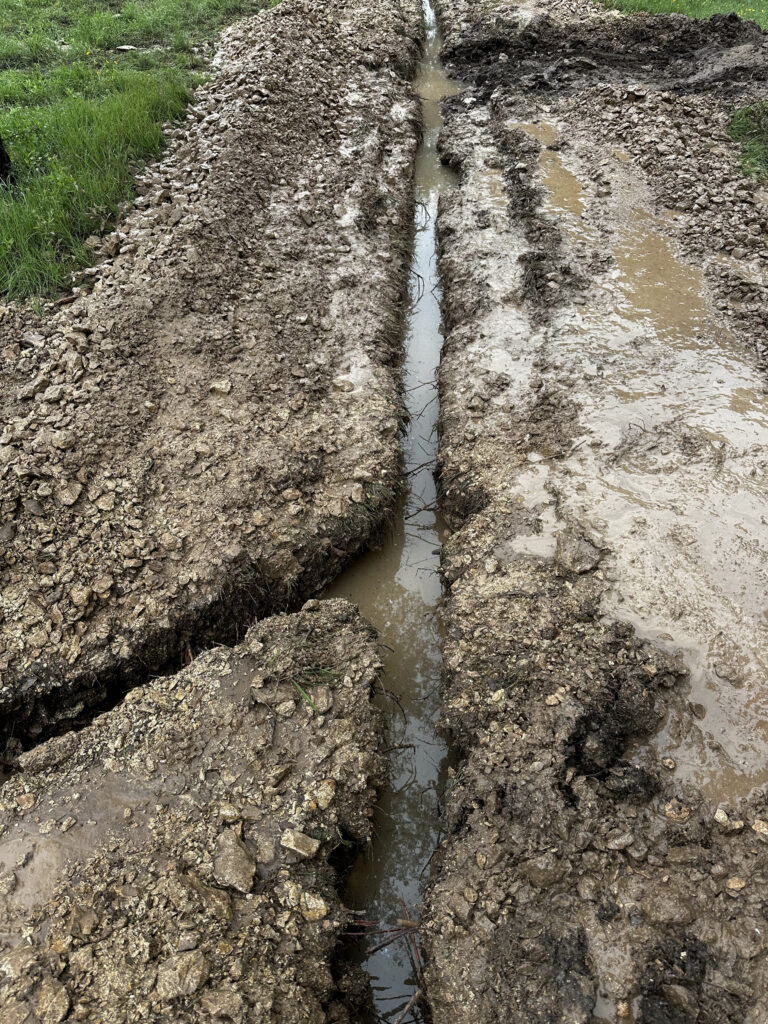
Central Texas land is beautiful — but it doesn’t take long for slopes, bare soil, and seasonal storms to turn a well-maintained property into a network of ruts, gullies, and washouts. Once erosion takes hold, it accelerates. Topsoil disappears, slopes destabilize, and water finds new paths that damage driveways, fences, structures, and pastures with every rain.
TexTerra Solutions provides professional erosion control services for landowners, ranchers, and residential property owners throughout Burnet County and Central Texas. We identify the root cause of your erosion problem and apply the right combination of regrading, drainage trenching, culvert installation, and French drain systems to stop it — permanently.
As a veteran-owned company with deep roots in Central Texas, we understand the specific soil conditions, rainfall patterns, and terrain challenges that drive erosion in this region. We don’t patch problems. We solve them.
What Causes Erosion on Central Texas Land
Burnet County’s soil conditions create a perfect storm for erosion. The region’s shallow, rocky soils over limestone bedrock hold limited moisture. When rain hits — and Central Texas spring storms in April and May, or fall rains in September and October, can drop several inches in a matter of hours — water has nowhere to go but across the surface. The result is runoff that moves fast, carries soil, and cuts new channels wherever it finds the least resistance.
Three conditions drive the erosion problems we see most often across Burnet County properties:
Slopes and Bare Soil
Sloped land loses topsoil fast when vegetation is removed. Site clearing, construction activity, and drought all leave bare soil exposed to direct rainfall impact. Without root systems anchoring the soil, even a moderate rain event triggers rill erosion — small channels that deepen rapidly into gullies with each subsequent storm.
Inadequate or Failed Drainage Infrastructure
When water doesn’t have a designed path off your property, it creates its own. That self-made path typically runs across driveways, through fence lines, under building foundations, and down unprotected slopes — carrying topsoil with it every time it flows. Properties with undersized culverts, no French drains, or improper surface grading are especially vulnerable.
Post-Clearing and Post-Construction Vulnerability
The period immediately after land clearing or construction is when erosion risk peaks. Bare soil, disturbed ground, and earth compacted by heavy equipment all increase runoff velocity. Without proper stabilization measures in place before the rainy season, one significant rain event can undo months of site work and create long-term drainage problems.
Erosion Control Solutions We Provide
Every erosion control plan starts with a site assessment. We identify where water is entering, where it’s moving, what it’s carrying away, and what it’s damaging on the way out. From there, we recommend the right combination of the following solutions.
Regrading & Slope Reshaping
Most erosion problems trace back to a slope that’s too steep, shaped incorrectly, or directing water toward structures instead of away from them. We reshape and regrade slopes to reduce runoff velocity, distribute water evenly across the surface, and establish stable contours that resist future erosion. Properly regraded land doesn’t just stop eroding — it improves in condition year over year as vegetation reestablishes.
For projects where regrading is part of a larger scope — home site preparation, barn pad construction, or agricultural land leveling — our land grading and site preparation services handle every phase from initial clearing through finish grade, ensuring drainage is engineered into the site from the ground up.
Drainage Trenching
When surface regrading alone isn’t sufficient, getting water underground is the most reliable long-term fix. We excavate trenches for drainage pipes, perforated drain tile, and diversion channels that capture runoff at the source and route it to a safe discharge point — away from your slopes, structures, and driveway.
Our professional trenching services are available as part of an integrated erosion control plan, whether your property needs a single drainage trench or a full underground network that intercepts water at multiple points across the site.
Culvert Installation
Low-water crossings, driveway approaches, and drainage channels often fail during heavy rain because culverts are undersized, clogged, or not set to the correct grade. We install properly sized culverts and ensure the inlet and outlet elevations are set to pass water efficiently without scouring the base material or backing up to flood the road.
French Drain Systems
French drains are one of the most effective solutions for chronic water pooling and subsurface moisture problems. A perforated pipe surrounded by gravel collects water along its length and routes it downhill to a safe outlet. We install French drains around building foundations, along fence lines, at the base of slopes, and in low-lying areas where water consistently pools after rain.
Swales and Diversion Berms
Graded swales and earthen berms intercept surface water before it reaches vulnerable areas and redirect it toward appropriate outlets. These are particularly cost-effective solutions for agricultural properties with predictable sheet-flow patterns, where a well-placed berm or channel can protect acres of improved pasture from recurring washout damage.
Bare Soil Stabilization
On recently cleared or disturbed sites, stabilizing exposed soil before the first significant rain is critical. We can grade and shape disturbed areas to minimize runoff velocity, and coordinate with revegetation to ensure the finished surface resists erosion as vegetation establishes.
Before & After — Erosion Control on Central Texas Properties
Erosion looks different on every property. Here are two examples of what the process looks like from problem to solution in Burnet County.
Ranch Property — Burnet County (Post-Clearing Slope Erosion)
| BEFORE | AFTER |
| 15 acres cleared for improved pasture. After the first spring storm, a gully 3 feet deep formed on the main slope and ran toward the stock tank. Sediment was filling the pond and gravel was washing off the ranch road at the low crossing. | TexTerra regraded the slope to a gentler pitch, installed a diversion swale along the upper edge to intercept sheet flow, and added two properly sized culverts at the road crossing. No additional gully formation through the following rainy season. Stock tank remained clear. |
Residential Property — Marble Falls Area (Foundation & Driveway Drainage)
| BEFORE | AFTER |
| Hillside lot receiving runoff from uphill neighbors. Water pooled against the foundation after every rain, landscaping was washing out, and the driveway base was beginning to sink on the uphill side. | French drain installed along the uphill property boundary to intercept sheet flow before it reached the foundation. Drainage pipe trenched to daylight at the lot’s low point. Yard regraded to direct surface water away from the structure. Pooling eliminated completely after the first test rain. |
Why Burnet County Properties Need Specialized Erosion Control
Erosion control in Burnet County is not the same as in the rest of Texas. The Hill Country’s geology, topography, and rainfall patterns create specific challenges that require local knowledge to address effectively:
• Shallow soils over limestone: Many Burnet County properties have only 4–12 inches of actual topsoil before hitting solid rock. Once that thin layer erodes, revegetation becomes extremely difficult and costly.
• Caliche hardpan: A dense caliche layer commonly found across the region blocks vertical drainage, forcing water to move laterally — often directly toward structures and driveways.
• Flash rain events: Central Texas receives intense, concentrated rainfall during spring (April–May) and fall (September–October). These events can deliver 3–6 inches in a few hours, overwhelming unprepared drainage systems instantly.
• Expanding clay soils: Parts of Burnet County have high-shrink-swell clay soils that crack severely during dry periods, creating surface channels that direct the first heavy rain directly into the subsoil and against foundations.
• Heavily vegetated slopes: Thick cedar and brush provide stability that isn’t replaced immediately after clearing. Post-clearing erosion risk is highest in the 6–18 months before ground cover reestablishes.
Understanding these conditions is what separates effective long-term erosion control from temporary surface patching.
Our Erosion Control Process
1. Site Assessment. We walk the property, identify erosion sources and flow paths, assess soil type and slope conditions, and determine where water is entering and exiting.
2. Solution Design. We recommend the right combination of regrading, drainage infrastructure, and stabilization measures based on your specific terrain and budget.
3. Transparent Estimate. You receive a clear, itemized quote before any work begins. No hidden fees, no surprises.
4. Efficient Execution. Our crew completes the work with minimal disruption to surrounding areas, operating the right equipment for the terrain.
5. Completion Walkthrough. We walk the finished site with you to confirm the solution meets your expectations and explain any long-term maintenance considerations.
Service Area
TexTerra Solutions provides erosion control services throughout Central Texas, including Bertram, Marble Falls, Lampasas, Temple, Georgetown, Leander, Liberty Hill, Johnson City, Dripping Springs, and surrounding areas. We regularly travel up to 90 minutes from our Bertram location.
Frequently Asked Questions
How do I know if my erosion problem needs professional help?
If you can see visible ruts, channels, or gullies forming on your property after rain events, the problem warrants professional attention. Small rills become large gullies quickly once the process starts, and the cost to repair increases significantly the longer the damage is left unaddressed. A free site assessment costs nothing and confirms whether professional work is needed.
Can you fix erosion caused by a neighbor’s runoff entering my property?
Yes. Offsite water entering a property and causing erosion is one of the most common problems we address. A properly designed French drain, diversion berm, or swale can intercept that flow at the property boundary before it reaches your slopes, driveway, or foundation.
Do I need a permit for erosion control work in Burnet County?
Most residential and agricultural erosion control projects — regrading, French drains, culverts on private property — do not require permits. Work that significantly redirects drainage across property lines or involves jurisdictional waterways may require coordination with the county. We’ll flag anything relevant during the assessment.
How soon after land clearing should erosion control be installed?
Immediately, if possible. The window between site clearing and the first significant rain event is when erosion risk is at its absolute highest. We recommend incorporating erosion control into the initial site work plan rather than scheduling it separately after the fact.
Will erosion control measures change how my property looks?
Properly installed swales, berms, and French drain systems blend naturally into the landscape, especially once revegetation occurs over disturbed areas. The visible change is minimal — the functional change is significant.